 EN
EN
 AR
AR
 BG
BG
 CS
CS
 DA
DA
 NL
NL
 FI
FI
 FR
FR
 DE
DE
 EL
EL
 HI
HI
 IT
IT
 JA
JA
 KO
KO
 NO
NO
 PL
PL
 PT
PT
 RU
RU
 ES
ES
 SV
SV
 TL
TL
 ID
ID
 UK
UK
 VI
VI
 HU
HU
 TH
TH
 TR
TR
 FA
FA
 AF
AF
 MS
MS
 SW
SW
 GA
GA
 CY
CY
 BE
BE
 KA
KA
 LA
LA
 MY
MY
 TG
TG
 UZ
UZ


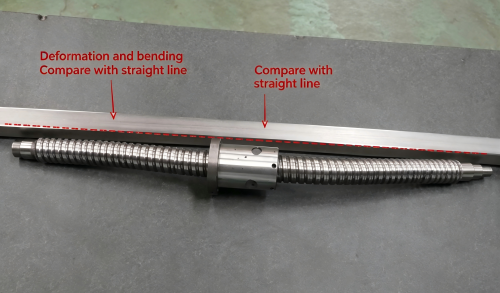
During equipment operation, many personnel have encountered the following situations: the slide table suddenly stops moving; the servo motor emits a dull, abnormal noise; the system alarms; or even the ball screw completely fails to rotate.Many people immediately suspect motor damage, drive alarms, or guide rail malfunctions. However, the real cause of equipment shutdown is often that the ball screw has become stuck or even locked.
As a precision transmission component, a stuck ball screw means loss of precision and equipment shutdown. The causes of sticking can usually be attributed to several factors, including foreign object blockage, lubrication failure, screw deformation, and installation problems.

I. Two Common Forms of Ball Screw Jamming
Intermittent Jamming: The screw can rotate, but becomes stiff, jammed, or vibrates when it reaches a fixed position, then returns to normal after a short time.
Complete Seizure: The screw cannot rotate in either direction, locks when manually turned, and is completely immobile.
II. Core Causes of Ball Screw Seizure
1. Foreign Object Intrusion and Mechanical Blockage (The Most Common Cause of Ball Screw Seizure)
Dust, chips, and other hard particles entering a poorly sealed system directly and physically block the ball circulation channel, causing immediate seizure or progressive seizure.
2. Lubrication Failure
Long-term lack of lubrication, dried-up and clumped grease, or use of the wrong grease type lead to increased friction and rapid wear until seizure.
Grease mixed with chips, moisture, and other impurities forms abrasive particles, accelerating raceway wear.

3. Ball Screw Deformation and Damage
Overtravel (Collision): Exceeding the effective stroke causes the commutator or reverser to break or fall off, causing the balls to seize in the return channel.
Long-term Overload: Prolonged overload operation causes slight bending of the screw shaft and deformation of the raceway, resulting in fixed-point seizure.
Excessive Temperature Rise and Thermal Expansion Seizure: The screw elongates due to thermal expansion, changing the original fit clearance. Severe thermal expansion can even cause it to “lock up” and become unable to rotate.
4. Installation and Drive Issues
Reverse Nut Installation, Misalignment: Misalignment of the circulator and raceway, causing direct jamming or jamming during operation.
Severe Out-of-Tolerance Installation Coaxiality/Parallelism: Misalignment or non-parallelism of the lead screw nut or the bearing housings at both ends will generate a huge radial load, forcibly causing jamming.
Excessive Preload: In order to ensure accuracy, excessive preload adjustment will directly lead to a sharp increase in frictional resistance, and in severe cases, immediate jamming.

III. What are the signs of a ball screw seizing?
The operation changes from smooth to stiff, with increased resistance.
Fine, intermittent abnormal noises and slight vibrations appear.
Reversal becomes slower, and positioning response is delayed.
The nut temperature rises significantly higher than usual.
There is always a fixed point of jamming during the reciprocating stroke.
IV. Preventive Measures (More Important Than Disassembly and Repair)
1. Regular lubrication
2. Maintaining complete protection
3. Avoiding overload impacts
4. Regularly checking the operating status
5. Proper rust prevention during long-term shutdowns
If abnormalities are detected early, many ball screws can still be used.
If the ball screw is already jammed, unable to move, or even seized, please continue reading “ Disassembly and Repair Methods for Seized Ball Screws “.