 EN
EN
 AR
AR
 BG
BG
 CS
CS
 DA
DA
 NL
NL
 FI
FI
 FR
FR
 DE
DE
 EL
EL
 HI
HI
 IT
IT
 JA
JA
 KO
KO
 NO
NO
 PL
PL
 PT
PT
 RU
RU
 ES
ES
 SV
SV
 TL
TL
 ID
ID
 UK
UK
 VI
VI
 HU
HU
 TH
TH
 TR
TR
 FA
FA
 AF
AF
 MS
MS
 SW
SW
 GA
GA
 CY
CY
 BE
BE
 KA
KA
 LA
LA
 MY
MY
 TG
TG
 UZ
UZ


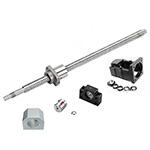
In our article ” Why do ball screw seize up? Reasons for jamming and locking“, we analyzed in detail why ball screw seize. Knowing the cause is only the first step. The key is how to disassemble and repair it.
It is particularly important to note that once a ball screw is seized, never force it to turn, as this may cause the steel balls to be squeezed out or scratch the raceway, resulting in permanent damage.
This method is suitable for jams caused by foreign objects, lubrication failure, or minor steel ball damage. If the screw is visibly bent (visible runout) or the raceway is deeply peeled off, it is recommended to replace it directly.

I. Safety Guidelines to be Followed Before Disassembly and Repair:
Immediately disconnect the power and stop the machine, cutting off the servo motor power.
Do not directly strike the lead screw or nut end face, as this can easily cause shaft bending and permanent damage to precision.
II. Standard Disassembly and Repair Procedures for a Seized Ball Screw
Step 1: Remove the Mechanical Load
Remove the worktable and nut connection plate to completely remove the load. Loosen the end supports and coupling screws to release the radial stress on the screw.
At this point, manually test the screw; many screws that are stuck due to improper installation will unlock directly.
Step 2: Move the Nut to the Safe Screw Shaft Section
If it can rotate slightly, slowly move the nut to the unthreaded smooth shaft position.
Step 3: Disassemble the external fittings of the nut
Remove the nut and carefully remove the external circulation pipe/end cap ball return mechanism, handling it gently to avoid breakage. Remove the old grease and pour out any remaining steel balls, debris, and iron filings.

Step 4: Conduct a Thorough Internal Inspection to Determine the Root Cause of Seizure
Carefully inspect under strong light to confirm that the screw raceway, nut inner wall, and ball returner are free of indentations, cracks, peeling, or other hard damage, and that there are no missing or broken steel balls.
Step 5: Targeted Fault Repair
1. Iron filings and impurities causing jamming:
Thoroughly clean impurities with a cleaning agent, then reapply special grease.
Replace damaged dust rings and bellows to restore sealing protection.
2. Broken or missing steel balls causing jamming:
Count the number of steel balls, select balls of the same specification, reload in the original order, and align the circulation channel.
3. Reversed or misaligned nut causing jamming:
Readjust the nut direction, ensure smooth alignment, and then reset. Avoid forcing it in.
4. Excessive preload causing jamming:
Fine-tune the preload to ensure smooth, gapless, and unobstructed operation.
Step 6: Standard Reinstallation and Reset
Clean the lead screw thread raceway, apply a layer of special grease, align the nut with the original markings, and slowly screw it in smoothly without resistance. Recalibrate coaxiality and parallelism.

III. Post-installation Debugging and Acceptance Standards
Manually rotate the nut throughout its entire range; no jamming, no stiffness, and no inconsistent pressure.
Low-speed, no-load reciprocating operation; no abnormal noise, no vibration, and no abnormal temperature rise.
A stuck ball screw does not necessarily mean it is unusable.
Some minor jamming can still be resolved by cleaning, replacing the balls, and relubricating.
However, if there is severe raceway damage, seizing and burning, or out-of-tolerance precision, replacement is generally recommended.